

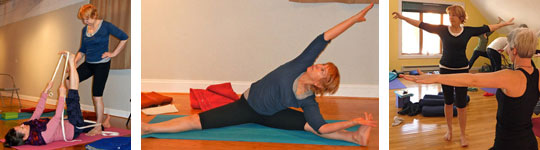
Each Month, starting January 2018 and continuing through December 2018, I will present concise illustrated instructions for a yoga pose (if not two or three) that you can practice along with. Strung together, the twelve poses make up a balanced yoga sequence. This sequence will incorporate a warm-up at the start, then poses to take you through a wide range of movement and focused work, and finishes with some resting poses.
January | February | March | April | May | June | July | August | September | October | November | December
|
 December
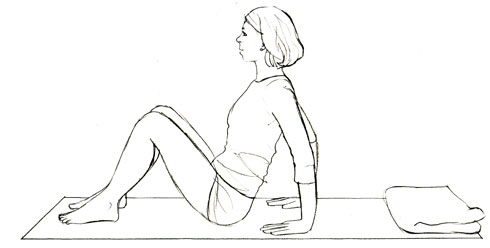 |
Sit on your mat, with your legs bent and your feet flat on the floor. 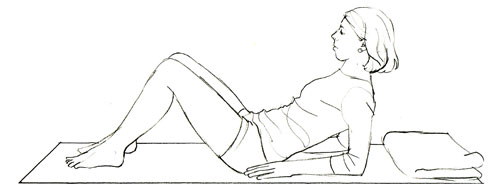 |
Lean onto your elbows, and lower your spine to the floor. 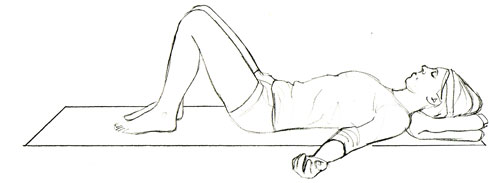 |
| Slide a folded blanket under your head and neck, to touch your shoulders. |
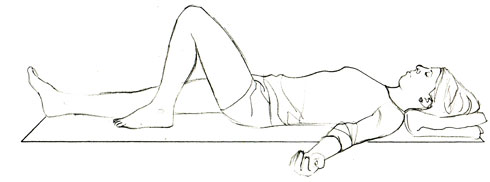
Straighten your legs. Carefully place them, one at a time, on the floor on the center of the back of the thighs and calves. Let your feet fall out to the sides. 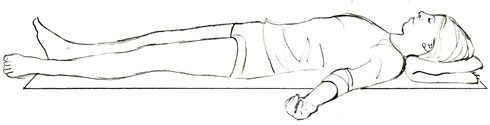 |
Our awareness gets dragged back to the surface of our being when the body tilts to one side. Therefore, take some time to carefully align the center of your chest, pelvis, inner legs, and heels; maintain an even weight on both sides of your body. Close your eyes. Relax your throat. In these reclining poses it’s important not to lose the meditative quality of the pose. Be present and stay with the moment. Let your belly relax and spread to the sides. Hold the sides of the mat, and roll your shoulders away from your ears. Elongate the back of your neck and rest your head on the center of the back of the skull. Extend your arms out to the sides so there is space between your upper arms and your side chest and armpit region. Turn them outward so that your palms face up. Allow your joints, even those at the back of the skull, to release and loosen. Release the skin on your forehead, from the hairline to the eyebrows, and then allow your brow to spread outward. Relax your inner ears and listen within. Relax your tongue and allow it to shrink and become smaller. Let go completely. Allow the breath to become soft and quiet. Draw inward and gaze into the internal space of your soul. Surrender the intelligence of the brain to the wisdom of your heart. Hold for 5—10 minutes. |
With thanks and gratitude to my teachers, BKS Iyengar (1918-2014), Prashant Iyengar, Geeta Iyengar, Abhijata Sridhar, and Sunita Parthasarthy.
Drawings and text © Bobby Clennell. All rights reserved. No reproduction without prior permission.